

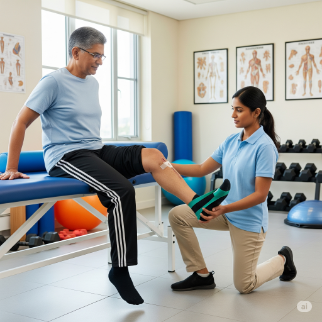
Post Total Knee Replacement (TKR) Physiotherapy

Post Total Knee Replacement Physiotherapy

Post Total Knee Replacement Physiotherapy at Home in Delhi NCR

Total Knee Replacement (TKR) surgery is performed to relieve pain and restore function in severely damaged knee joints, often due to arthritis or injury. After surgery, physiotherapy is an essential part of the recovery process. It helps patients regain mobility, improve knee strength, restore flexibility, and return to normal daily activities safely and effectively. A structured rehabilitation program ensures faster healing, reduced stiffness, and long-term success of the knee replacement.

Total knee replacement surgery gives patients a new lease on mobility, but the real recovery begins after the operation. Physiotherapy after knee replacement is the single biggest factor in how quickly a patient regains strength, flexibility and independence. At Eternia Physio, we provide knee replacement physiotherapy at home across Delhi and Delhi NCR, so patients can recover in comfort without the stress of travelling to a clinic during the most sensitive phase of healing.

Why TKR Physiotherapy Cannot Be Skipped

Total knee replacement physiotherapy is not an optional add-on to surgery. It is a structured part of the treatment itself, closely related to recovery protocols used for post knee and hip replacement patients more broadly. Without guided physical therapy after total knee replacement, patients often develop stiffness, muscle weakness around the new joint and a limping gait that can become permanent if not corrected early. A qualified physiotherapist works on:

  • Reducing post-surgical pain and swelling.
  • Restoring full range of motion in the knee.
  • Rebuilding quadriceps and hamstring strength.
  • Correcting walking pattern and balance.
  • Preventing scar tissue stiffness.
  • Helping the patient return to stairs, sitting, and daily activities safely.

Most surgeons expect physiotherapy for total knee replacement to begin within 24 to 48 hours of the operation, and to continue in a structured way for at least 8 to 12 weeks.

TKR Physiotherapy Treatment: How It Progresses

Physiotherapy treatment for total knee replacement is usually broken into three clinical stages, each with its own goals.

  • Early stage (Week 1 to 2): Focus is on gentle range of motion exercises, ankle pumps, quad activation, and safe transfers from bed to chair. Pain and swelling management is a priority at this stage.
  • Intermediate stage (Week 3 to 6): The physiotherapist introduces resisted strengthening, balance training, and supported walking. Bending and straightening the knee fully becomes a key milestone. This stage overlaps closely with protocols used in post ACL reconstruction physiotherapy, since both rely on progressive loading of the knee joint.
  • Advanced stage (Week 7 to 12 and beyond): This phase targets functional strength, stair climbing, longer walking distances, and return to normal household or work activities. Some patients continue supervised sessions up to 6 months for full total knee replacement physiotherapy recovery.

Every patient heals differently, so the plan is adjusted based on age, pre-surgery fitness, and how the joint responds week to week. This is especially true for older adults, where recovery timelines are covered in more detail on our geriatric physiotherapy page.

Benefits of Home Physiotherapy After Knee Replacement

Choosing knee replacement physiotherapy at home over clinic visits offers real advantages, especially in the first month after surgery:

  • No painful travel on a freshly operated knee
  • One-on-one attention in every session, unlike crowded clinics
  • Exercises adapted to the actual layout of the patient's home, stairs and furniture
  • Lower risk of infection compared to a hospital or clinic environment
  • Family members can be trained to assist safely between sessions
  • Flexible scheduling that works around the patient's energy levels and pain cycles

For elderly patients in particular, home physiotherapy for TKR patients removes one of the biggest recovery barriers: the physical and emotional stress of getting to an appointment.

Home Physiotherapy Services Near You in Delhi NCR

Eternia Physio provides physiotherapy after TKR directly at the patient's doorstep across Delhi NCR. If you are searching for post TKR physiotherapy near me or home physiotherapy near me for knee replacement, our therapists are available across:

  • Delhi, including South Delhi, West Delhi, Dwarka and Rohini
  • Gurugram
  • Noida and Greater Noida
  • Ghaziabad
  • Faridabad

Whether you need physiotherapy after knee replacement in Delhi or a knee replacement physiotherapist near me in Gurugram, Noida, Ghaziabad or Faridabad, our team reaches you with the same equipment, protocols and clinical supervision you would expect from a hospital-based rehabilitation program. You can browse our full range of physiotherapy services to see how TKR care fits within our broader offerings.

What to Expect From a Home Visit

Each home physiotherapy session for total knee replacement includes a review of pain levels and swelling, guided exercises using resistance bands and light equipment, gait and balance training where appropriate, and clear instructions for the patient and caregiver to follow between visits. Progress is tracked session to session so the plan keeps pace with recovery instead of following a fixed template.


Book Home Physiotherapy After Knee Replacement

If you or a family member has recently undergone total knee replacement surgery and needs structured physiotherapy at home in Delhi NCR, Eternia Physio's therapists can begin sessions within days of discharge. Book a home visit today and start recovery on the right track.

  • Why is physiotherapy important after TKR surgery?

    Physiotherapy is vital after TKR as it reduces pain and swelling, restores movement, strengthens knee muscles, and helps patients walk independently again.

  • How soon should therapy begin after surgery?

    Rehabilitation usually begins within 24–48 hours after surgery under supervision. Early movement helps prevent stiffness and speeds up recovery.

  • How long does recovery take with physiotherapy?

    Most patients regain significant mobility within 6–12 weeks of regular physiotherapy, with continued improvement up to a year after surgery.

  • How soon after TKR surgery should physiotherapy start?

    Most patients begin gentle movement and physiotherapy within 24 to 48 hours after surgery, usually while still in the hospital, and this continues at home once discharged.

  • How long does total knee replacement physiotherapy usually take?

    Most patients see significant improvement in mobility within 6 to 12 weeks of consistent physiotherapy, with continued gains for up to a year in some cases.

  • Is home physiotherapy as effective as clinic-based physiotherapy after TKR?

    Yes. For most patients, especially in the early weeks after surgery, home physiotherapy is equally effective and often safer, since it removes travel stress and allows exercises to be tailored to the patient's actual home environment.

  • Do you provide TKR physiotherapy across all of Delhi NCR?

    Yes. Eternia Physio provides home physiotherapy for knee replacement patients across Delhi, Gurugram, Noida, Greater Noida, Ghaziabad and Faridabad.

  • What does a typical TKR physiotherapy session include?

    Sessions typically include pain and swelling assessment, range of motion exercises, strengthening work, and walking or balance training, adjusted to the patient's stage of recovery.